Demonstrating MUSICA in 3d Modeling
For the past several years, the MUSICA software engineering team has been creating a software library that represents atmospheric chemistry processes in a model independent and runtime configurable fashion so that MUSICA can interface with any atmosphere model. In the January 2024 newsletter, we showed this vision for MUSICA software development; a simplified version of the schematic is repeated in Figure 1.
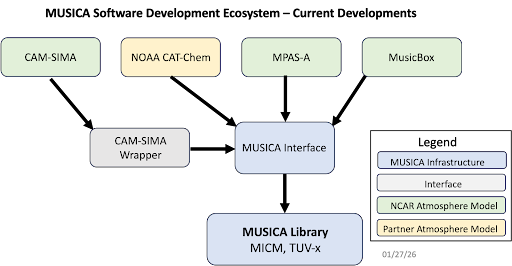
Figure 1. MUSICA software development ecosystem depicting the current developments. Arrows show what each element is dependent upon.
The MUSICA Library contains the Model Independent Chemistry Module (MICM) that solves gas-phase chemistry with an ODE solver and the Tropospheric Ultraviolet and Visible radiation code eXtended (TUV-x) to the whole atmosphere that calculates photolysis rates. In 2025 the CAM-SIMA wrapper was completed allowing MICM and TUV-x (and any future module that will be introduced into the MUSICA Library) to be connected to CESM’s next generation Community Atmosphere Model (CAM), called CAM-SIMA. A demonstration of Terminator chemistry was then performed.
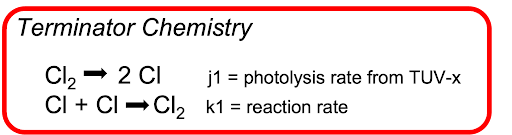
Figure 2 shows the Cl mixing ratios and the change in Cl2 mixing ratios for hour 16 of a 24-hour simulation. The photochemistry produces high Cl in the daylit regions, when Cl2 experiences some depletion. The summation of Cl and Cl2 is conserved. To further demonstrate MUSICA capabilities, the species Foo is introduced via a JSON file. The demonstration has Foo produced by Cl2 photolysis and destroyed through reaction with Cl and reaction with itself. Thus, a species and its reactions are demonstrated to be added to a 3-dimensional chemistry transport model without the need to recompile the code base.
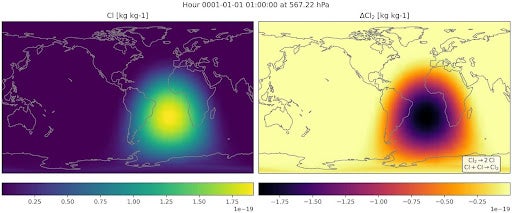
Figure 2. Latitude-Longitude cross section at 567 hPa of Terminator chemistry running in CAM-SIMA at hour 1 of a 24-hour simulation. Panels a) and b) display Cl mixing ratios and the change in Cl2 mixing ratios from its initial mixing ratio, respectively.